                  |
  
June 2009 Newsletter
NEEDS for the clinicAn example of what is happening—patients thru clinic:
That is 1,346 for 2007, 2,015 for 2008 and 3,622 for 09
Since the hospital doesn’t have supplies, the burn patients have stopped going there first and come directly to FHL. It is really important to get as many of the supplies here and ship them as possible. For example, the girls ran out of gloves before Roseline got back down there and in Cap Haitien they paid $150 a case, we got 3 cases for $195 in Florida, so there is a BIG difference. In the case of multiple injuries from a voodoo ceremony (including the Priest) the clinic used 10 jars of SSD for burns in one day...
CONTRIBUTIONSPulled numbers and as of 5/13 we were down 31% from the same day in 2008. If this trend continues, we will have to make some serious decisions about where to cut program services. As you can see above, the patients for 2009 are more now than the total of 2007 and 2008 for the same period. If you have any ideas, please let us know. I am only one person stateside so if your ideas involve time—I need you to volunteer to also do it. It is especially difficult right now because we have so much money in the food on the wharf and still must buy bulgur wheat and corn meal to give the people “something” to eat.
PROCLAIMERSFaith Comes by Hearing distributes radios to poor nations that are wonderful, they are either AC or Solar and they are pre-programmed with the New Testament in Haitian Creole (in our case). We were privileged to receive a case of them. The security guys listen to it all night and all day, the waiting patients hear them. Presume carried it everywhere with him while he was in Florida and now back in Haiti, is using them with the Sunday School class and with orphans … what a wonderful way to share God’s message. Whether people can read or not hearing has a special way of reaching those listening.
THINK POSITIVEThe absolute last thing I want to do is depress you, we are doing a LOT of good and as soon as those containers come off the wharf we will be doing even more … and that is all because you have been willing to share in these times of such uncertainty and we really, really appreciate it! 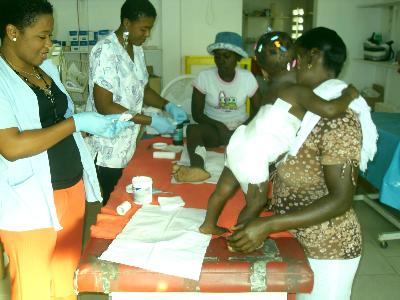
An example, the baby above with an extensive burn over his backside would not have been treated had not someone sent $17 for the SSD cream, and money for the rolled gauze bandages and the tape to protect it and keep it clean… thank you! By the way, we do have two exam tables, beats me why the girls work two patients on the same table.
BEANSGood news. One of the things about working in Haiti for the past 40 years that I should remind myself of… but always seem to forget: Don always said we have an 11:59 God. Just when I had truly given up on getting any of the beans off the wharf before they spoiled… we got news Friday that on Thursday they had been inspected and bags opened through the process and everything checked was still good. Praise God—He watched over them for sure. You may recall that they had been containerized since October! As I write there is no word when we will actually get them, but at least there is a light at the end of the tunnel that just may not be a train! That would be one down and two to go—the other two have been there since April 20. It is important that we get this food, I just got the last expense report via e-mail from Roseline and they paid $80 US per 100# bag of beans, they did find rice for $58 for 110# bag and $30 a bag for bulgur wheat. That was $7500 for the food program with two and a half containers of food sitting of the wharf! I know Tony is considering me a nag and by now the guys at the wharf area probably thinking the same of Présumé, Roseline and CASCO’s people. We must, however, work on the old adage of “the squeaking wheel gets the grease” and make sure they understand we won’t give up until they “free” our food.
MORE GOOD NEWSWe got news from the Pilgrim Lutheran Church of Indianapolis that they area honoring our request for funding Pilgrim House #19. They approved $7,000 which is not enough in today’s economy to build a family home. However, anticipating how it might work out, we have picked out a family that really needs another room or two (depending on what we can do on their lot) and improvement son their existing home. This grant will be perfect and this project will be Pilgrim House #19, now we just gotta hold back the workers until we get the funds they get sooo excited! 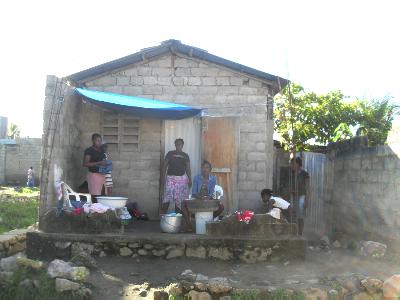
PRAYER PLEASE?Following all this wonderfully uplifting news we are going to request prayers, please: *Getting the inspected and yet-to-be inspected food off the wharf for distribution to the poor *Patience with the enthusiasm for starting Pilgrim House #19, and success for that family. *Tim to have success with grant writing to get the rest of the needed fund for the truck and other projects for this Lord’s work. *Christmas in August is scheduled for August 10th so it is now time to start getting serious with those plans. We already had one reservation by this time last year. Reservation forms will be in the next newsletter, but you can make online reservations if you like. *Guidance for Rob as he re-organizes his scheduling and priorities… that he has the opportunity to join us in Haiti soon and time to write the next newsletter. *Wisdom for the FHL leadership as we face the belt tightening required in today’s monetary setting that we make wise choices and that all that we do be pleasing to the Lord and always give God the Glory. Beyond the highest leaf, But when it’s answered, oh my friends, How strong is our belief! An act of love may simply be A smile, a hug, a kiss… But it’s a joy for all to see When troubles come like this. —-Clay Harrison
Take a moment to sign our Guestbook. Thank you!
e-mail us:  Mission Field Worker: Roseline DeHart Newsletter Editor: Eva DeHart
|


 Please e-mail me your e-mail address! I won't solicit anything but prayers on special needs and also utilize it to save my wrist, cards and 24¢ for thank you cards.e-mail us:
  Previous Newsletters